Strong Muscles. Stronger Bones.
Building and maintaining muscle is one of the most powerful things you can do to support your bones, balance, mobility, and independence as you age. The goal isn't simply to exercise more. It's to move in ways that give your bones and muscles the right kind of challenge.


Walking is wonderful for your heart, mobility, mood, balance, and overall health.
But here's something many women are never told:
Being active and building bone are not necessarily the same thing.
If you've been walking the same neighborhood, at roughly the same pace, for years, your body has become very good at doing it. That's one of the remarkable things about the human body, it adapts.
But when it comes to bone, adaptation creates an interesting challenge.
Once your bones are accustomed to a particular activity, that activity may no longer provide enough of a new mechanical challenge to encourage meaningful bone-building adaptation.
Your walk is still good for you.
Your bones may simply need a different kind of challenge.
Bone is living tissue, and it responds to the forces placed upon it.
In simple terms:
Bones adapt to what we ask them to do.
When bone experiences an appropriate mechanical challenge, it receives a signal to adapt. But when the challenge stays the same over time, the body becomes accustomed to it.
That's why bone-focused exercise isn't simply about doing more.
It's about providing the right kind of challenge.
Bone-building exercise isn't one single activity.
Different types of movement challenge your body in different ways. Some place greater forces through the skeleton. Some strengthen the muscles that pull on bone. Others improve the balance and stability that help protect you from falls.
For a well-rounded bone-health strategy, we want to think about four important areas:

These are activities performed while your bones support your body against gravity.
Examples may include walking, hiking, stair climbing and dancing.
Weight-bearing movement is important, but remember: if your body is already very accustomed to an activity, simply doing more of the same may not provide a new bone-building challenge.

Muscles pull on bones when they contract.
Strength training creates resistance that challenges both muscle and bone.
Resistance may come from weights, machines, resistance bands or your own body weight.
As your body becomes stronger, the challenge may need to gradually progress.
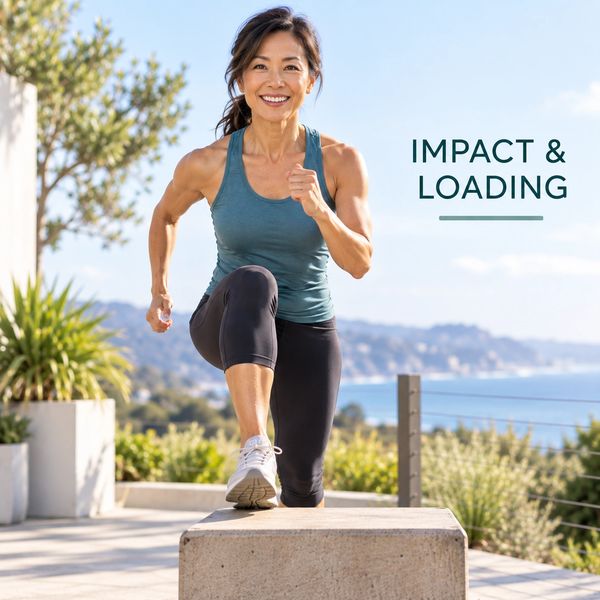
Activities that create greater forces through the skeleton can provide a different stimulus than everyday movement.
Depending on the individual, this might include faster stair climbing, hopping, jumping or other higher-impact movements.
But higher impact is NOT appropriate for everyone, especially when fracture risk is elevated.
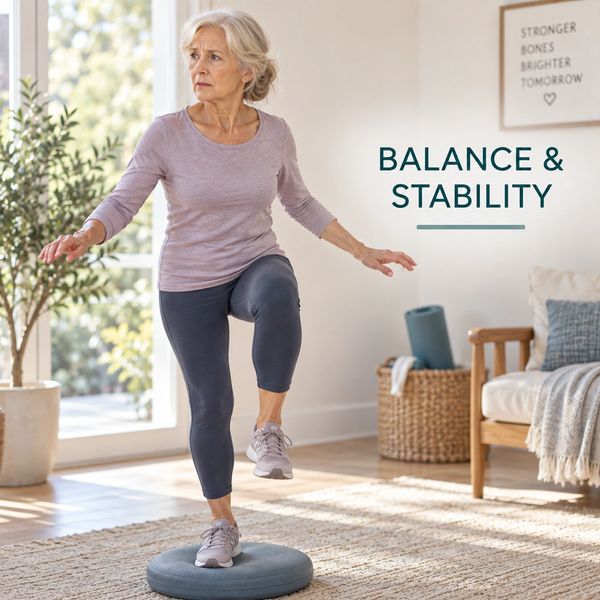
Balance training doesn't necessarily build bone directly, but it can help protect the bones you already have.
Improving balance, coordination and lower-body strength may reduce the likelihood of falling.
Because preventing a fracture also means preventing the fall that can cause one.

Sandy
The goal of bone-focused exercise is not to create the biggest impact possible. It is to provide enough of a challenge to stimulate adaptation—while staying appropriate for your body and your level of fracture risk.
For one woman, that challenge might be adding resistance to a strength exercise. For another, it might be climbing stairs, increasing weight, moving more quickly, or introducing carefully selected impact.
And for someone with osteoporosis, a previous fracture, poor balance, pain, or other medical concerns, certain types of impact may not be appropriate at all.
The right amount of challenge is individual.
Your body is remarkably good at adapting.
A weight that once felt heavy eventually feels light. A challenging set of stairs becomes easier. A resistance band that once made your muscles work may eventually feel comfortable.
That's progress and it's a good thing.
But it also means that doing the exact same exercise, with the same resistance, at the same intensity, year after year may no longer provide the same challenge.
To continue creating a meaningful stimulus, exercise often needs to progress as your body becomes stronger.
When appropriate, gradually increasing resistance can create a new challenge for muscles and bones.
Progress isn't only about heavier weights. Speed, movement, resistance, direction, impact, or exercise difficulty can change the forces your body experiences.
Challenge provides the stimulus. Recovery gives your body time to respond, repair, and adapt.
Strong muscles help you lift, carry, push, pull, climb, and move through everyday life.
Muscle contractions create forces through the skeleton, making resistance training an important part of a bone-focused exercise strategy.
Strength, especially through the legs and core, works together with balance and coordination to help you stay steady and recover when you lose your footing.
Maintaining muscle helps preserve the physical ability to keep doing the things you love as you age.
Sandy
Bone health isn't about doing everything perfectly.
It's about understanding what your body needs and making thoughtful choices that support your strength, mobility, and independence for the years ahead.
Move with purpose. Build strength. Challenge your bones appropriately. Protect your balance.
Small, intentional choices today can help support a stronger, more confident tomorrow.
If you have osteoporosis, a history of fracture, significant balance concerns, or are unsure which activities are appropriate for you, talk with your healthcare provider or a physical therapist before adding higher-impact exercise.
CONTACT
Educational guidance / Not medical diagnosis or treatment
Copyright © 2026 - All Rights Reserved.
We use cookies to improve your website experience, analyze traffic, and better understand how visitors use our site.